Solar
Is Solar Panel Cleaning Worth It in Canberra?
Often less than people expect. Rain keeps tilted panels fairly clean in Canberra, but flat or low-tilt panels, bird droppings, nearby trees and dust can cost noticeably more output.
By ACT Gutter Vacuum
Last updated · 8 sources
- ~70 daysOf rain a year in Canberra
- 10°+Tilted panels mostly wash clean when it rains
- 0.8%Average yearly gain from one mid-season clean in the UC San Diego study
Often less than people expect. Canberra gets rain on about 70 days a year, and panels tilted at more than about 10 degrees mostly wash clean when it rains, so the gain from a clean is usually a few per cent. Cleaning clearly pays when your panels are flat or nearly flat, when birds use them, when trees drop leaves or sap on them, or after a dusty or smoky summer.
The honest test is your own monitoring app: if a clean brings output back up noticeably, it was worth it. If not, save your money until it is.
What the research says
The best-known study of dirty panels was done by Felipe Mejia and Jan Kleissl at UC San Diego, who tracked 186 solar systems across California. What they found:
- Panels lost about 0.051% of their output per day without rain, on average.
- Over California's long dry summer, about 145 days, that added up to about 7.4%.
- A day with about 2.5 mm of rain was enough to bring a panel back to clean.
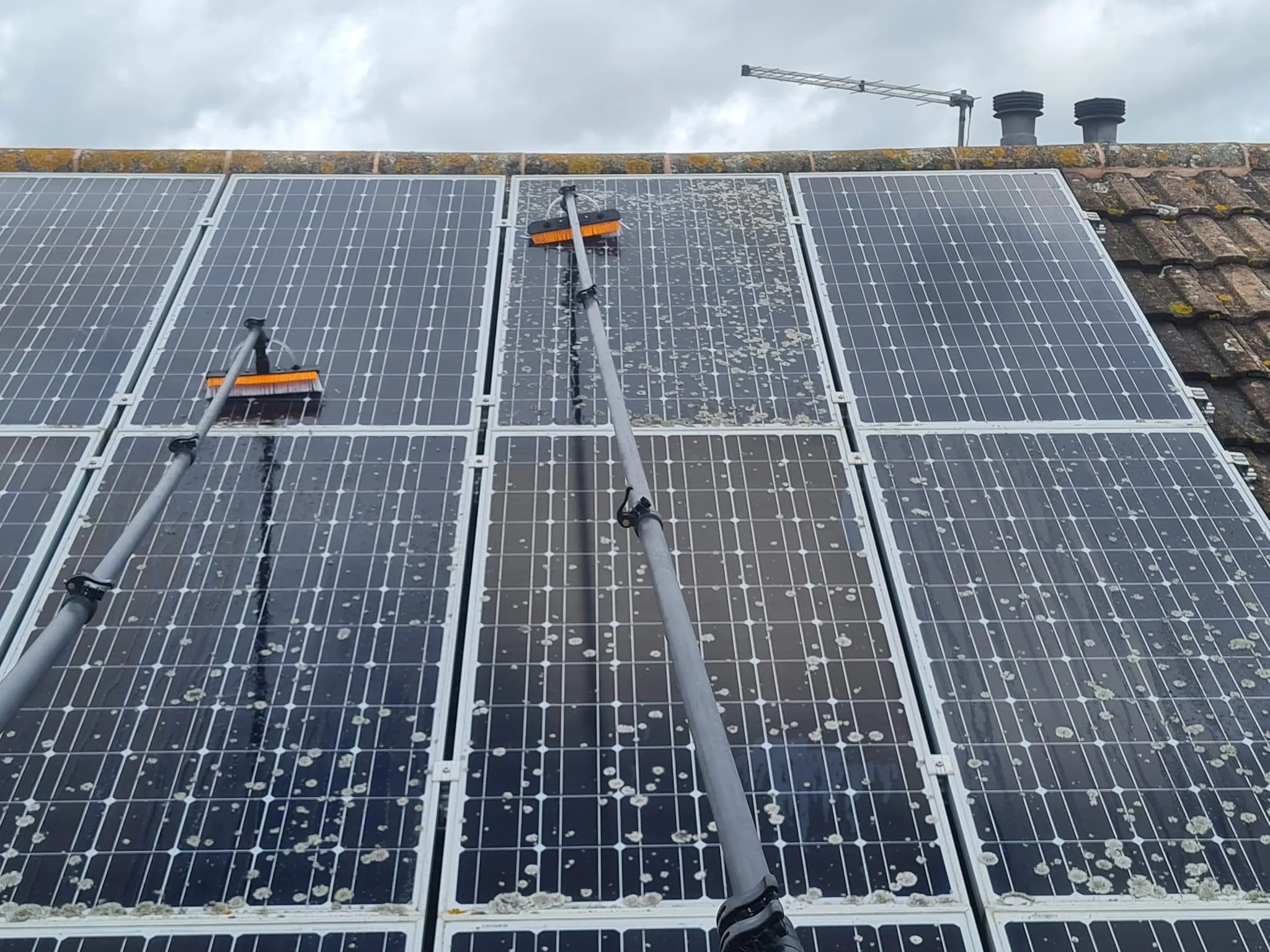
- Panels tilted under 5 degrees lost about five times as much as steeper ones.
- One clean in the middle of the dry season gained only about 0.8% more energy over the whole year on average, and up to 4% at the dirtiest sites.
California's dry summers are much longer than Canberra's. Canberra Airport averages around 615 to 640 mm of rain a year, and no month is usually dry: every month averages several rain days. With rain every few weeks, a tilted panel here rarely builds up the months of dust the Californian ones did.
So for an ordinary tilted roof, the payback from cleaning alone is modest. The bigger losses come from a few specific things.
When cleaning clearly pays
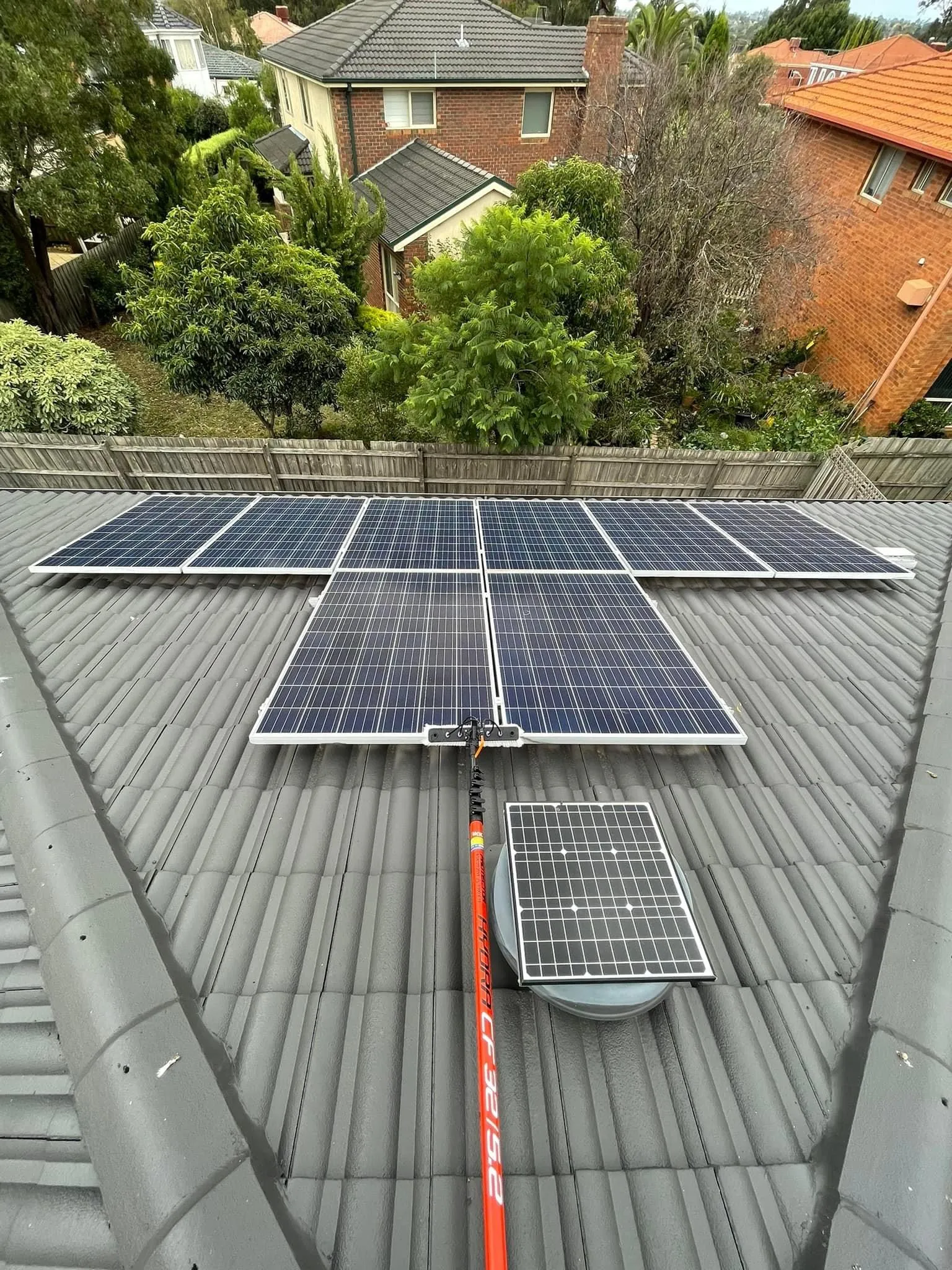
Flat and low-tilt panels. Panels laid almost flat on a commercial roof, or on a low-pitched carport or shed, don't shed dirt in rain. Water pools and dries, leaving a band of grime along the bottom edge. These are the panels most likely to need regular cleaning.
Bird droppings. A dropping blocks light completely on the cells it covers, and rain doesn't shift it. Because cells are wired in groups, shading a small part of a panel can cut far more output than its size suggests. Research from the US National Renewable Energy Laboratory found a shadow can reduce power by more than 30 times its physical size on some systems.
Trees overhead. Leaves, sap, blossom and pollen stick to the glass and build up, and leaves caught along the frame trap more dirt.
Dust, smoke and ash. Panels near unsealed roads, building sites or farmland collect more dust. During the 2019-20 bushfires, CSIRO reported Canberra rooftop output fell 45% on New Year's Day 2020. Most of that was smoke in the air blocking the sun, which cleaning can't fix, but CSIRO also notes ash can leave a thin layer of grime on the panels afterwards.
How to check your own system
Before paying anyone, see what your panels are actually doing.
- Open your inverter's monitoring app and look at daily output on clear, sunny days.
- Compare a sunny day just before a good rain with a sunny day just after. If output jumps after the rain, dirt was costing you.
- Compare this year with last year for the same month. A steady drop on clear days, with no new shading, points to dirt building up.
- Look at the panels from the ground or a window. Bird droppings, leaves along the frame, or a brown band at the bottom edge are easy to spot.
If output hardly changes after rain, your panels are cleaning themselves well enough. If one panel or one string is well below the others, look for droppings, leaves or a new shadow from a growing tree.
Working out whether it pays for you
You can put a rough number on it with your own figures:
- Find your system's yearly output in your monitoring app or on your power bills.
- Estimate the gain from a clean. For tilted panels with nothing on them, use the after-rain test above. If output barely changes after rain, the gain from cleaning will be small too. For flat panels or panels with droppings, the gain is bigger.
- Put a value on it. Power you use yourself is worth what you'd pay the retailer for it. Power you export is worth your feed-in tariff, which is usually much less.
- Compare it with the cost of a clean.
As an illustration only: if a clean lifted a system's output by 3% for the rest of the year, and that system's yearly output was worth $1,000 to the household, the clean would be worth about $30 in power. That won't cover a professional clean on its own. If droppings or dirt were costing 10% or more, it might.
That's why the honest answer is "sometimes". Many people book a clean for other reasons too: they're having the gutters done anyway, the panels look dirty from the street, or they want a close look at the panels and the roof around them.
Cleaning safely
The panel makers and the Australian Government agree on the basics:
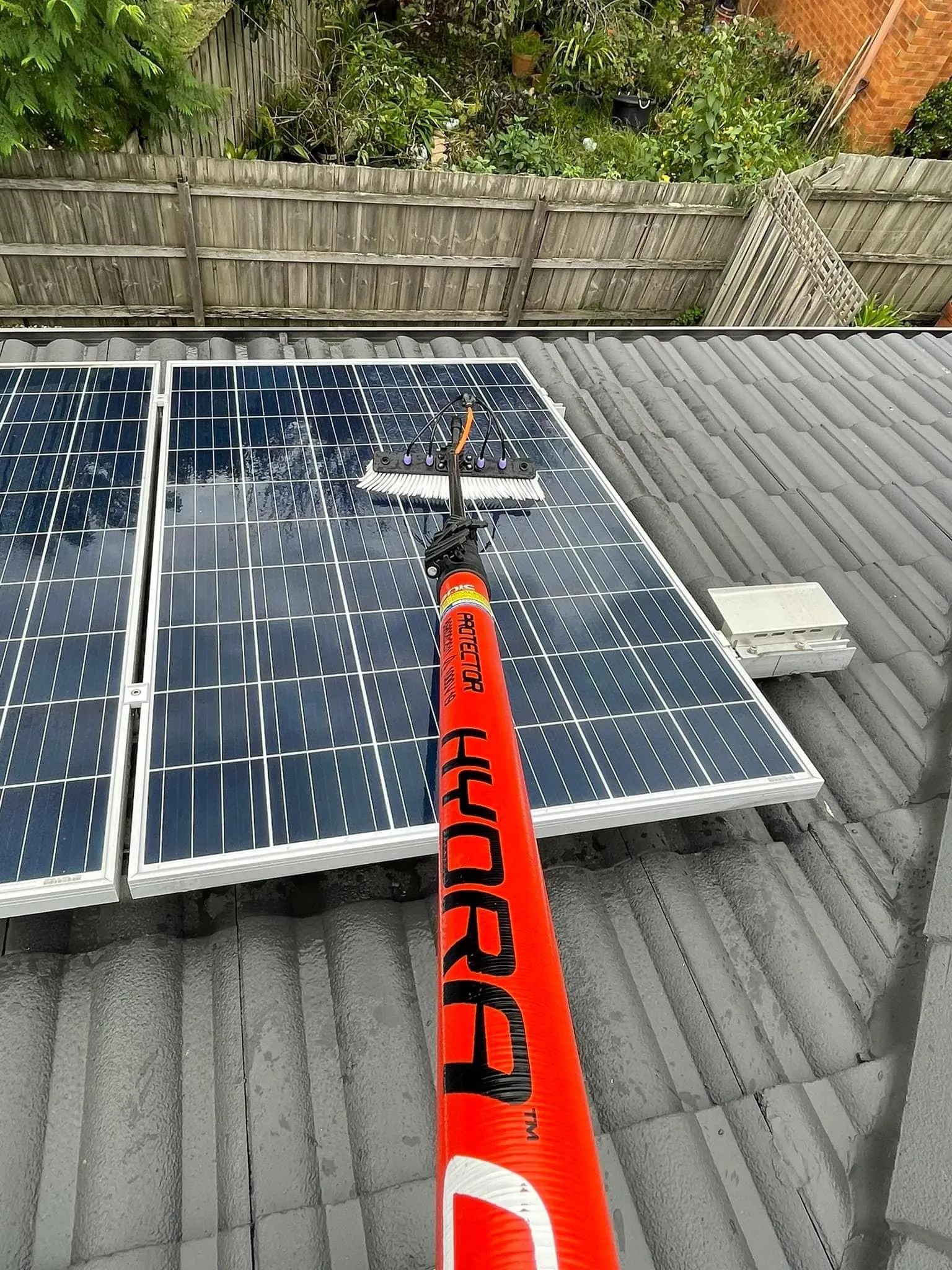
- Plain water. The Your Home guide says to avoid harsh soap or chemicals; usually water is enough. Manufacturers such as Jinko and Canadian Solar specify water low in minerals, because hard water dries into spots.
- A soft brush. Nothing abrasive on the glass, and no dry scrubbing.
- No pressure washer. Solar Victoria says never use a pressure hose.
- Don't stand on the panels. It can crack the cells, even when you can't see the damage.
- Clean when they're cool, early or late in the day, not in full sun.
Getting it wrong can cost more than dirt does. Canadian Solar's manual says improper cleaning will void its warranty.
We clean panels with purified water and a soft brush on a water-fed pole, without chemicals or a pressure washer, and without walking on the panels. Our solar panel cleaning page explains the service.
DIY or professional?
If your panels are on a single-storey roof and you can reach them with a brush on a pole from the ground, cleaning them yourself is reasonable. Use a hose, a soft brush and plain water, and stay off the roof.
Pay for it when the panels are on a second storey or a steep roof, when you'd need to climb to reach them, or when the job is bird droppings or sap that a hose won't shift. A fall from a roof costs far more than a year of dirty panels.
It also pays to combine it with something you'd do anyway. We can clean the panels and the gutters in the same visit, and trees that drop leaves on your panels are usually filling your gutters too.
Frequently asked questions
On tilted panels, usually a few per cent. A large study of Californian systems measured an average loss of about 0.05% a day, adding up to about 7% after a five-month dry summer. Canberra rarely goes that long without rain, so typical losses here are smaller. Bird droppings and flat panels are the exceptions.
For tilted panels with nothing overhead, once a year or when your monitoring app shows a drop is plenty. Flat or low-tilt panels, panels under trees and panels that birds sit on may need it every six months.
Mostly, if they're tilted. The Australian Government's Your Home guide says panels at more than about 10 degrees should mostly be washed clean by rain. Rain doesn't shift bird droppings or sticky sap, and on flat panels it leaves a ring of dirt along the bottom edge.
From the ground with a hose and a soft brush on a pole, yes, if you can reach. Use plain water, no detergent, and never a pressure washer. Don't climb onto the roof or stand on the panels.
Sources
- Mejia, F. and Kleissl, J. (2013), Soiling losses for solar photovoltaic systems in California, Solar Energy 95, 357-363.
- Deline, C. (2009), Partially shaded operation of a grid-tied PV system, National Renewable Energy Laboratory.
- Australian Government, Your Home: Photovoltaic systems.
- Solar Victoria, Maintenance guide.
- CSIRO, Solar power and extreme weather in Australia (2020).
- Canadian Solar, Installation manual for PV modules (rev. 2.7).
- JinkoSolar, Installation manual (2024).
- Bureau of Meteorology, climate statistics for Canberra Airport and Canberra Airport Comparison.
Panels need a clean?
We clean panels with purified water and a soft brush, never a pressure washer. Tell us how many panels you have and we'll send a free quote.